
Thomas Crisp

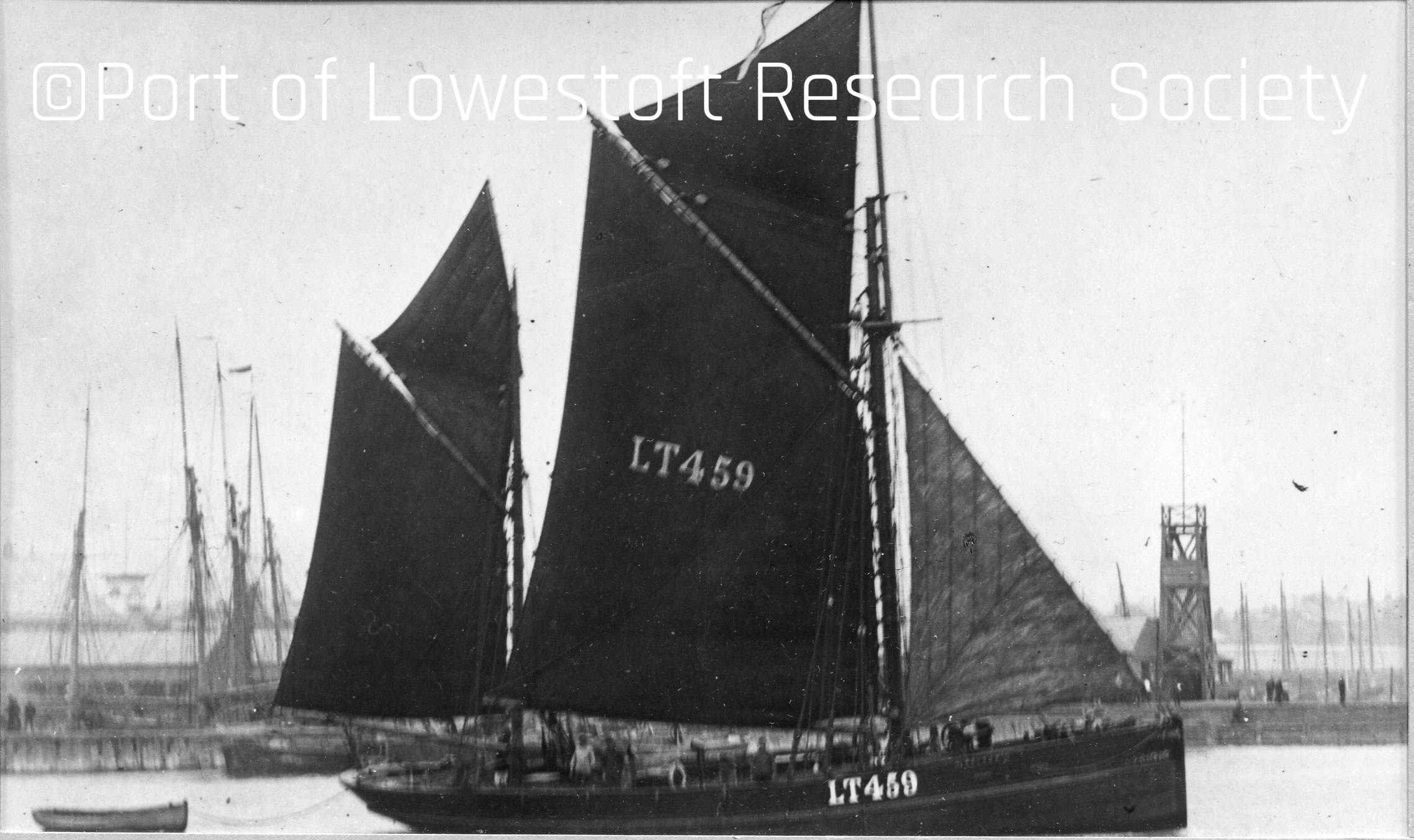
A Skipper with H.M. Smack Nelson, Thomas died on 15th of August 1917 at the age of 41.
Thomas, also known as Tom, was born at Lowestoft on 28 April 1876, a son of William and Mary Ann Crisp. In 1881 his family lived at 3 Rant Score East and by 1891 at 17 Seago Street.
On 2 June 1895 Thomas married Harriet Elizabeth Alp at Saint Margaret’s Church. Thomas was a trawlerman and they both gave their address as 4 fir Lane. By 1901 they were living near Holly Farm, on Staithe Road, Burgh St. Peter, and Thomas was the mate on a fishing smack.
Thomas went to sea as a young man, initially as a fisherman and then, for a time in the Merchant Service when he became a quartermaster on the S.S. Mobile. Subsequently he returned to fishing and was awarded his certificate of competency as a skipper in 1904. Tom worked for the Chambers family and was, for many years, Skipper of the ketch George Borrow.
By 1911 Thomas and Harriett’s home was at 56 Roman Road and by 1915 they had moved to 27 Stanford Street. Harriett died, at Lowestoft, on 12 June 1917.
Their son Thomas William, who was with Thomas when he died, lived at 41 Stanford Street.
On 15 December 1915 Thomas joined the Royal Naval Reserve as a Deck Hand. He served in the trawler Ocean Fisher before, on 21 January 1916, joining the trawler Telesia LT 1155, a decoy or Q Ship. On 8 February 1916 Thomas joined the trawler Energic, LT 1195, another Q Ship.
Thomas was advanced to Temporary Skipper on 28 February 1916 and joined the trawler Bird, LT 649, another Q Ship. Thomas’ service record does not show the exact date, but he took command of the trawler I’ll Try and this was before February 1917: his son Thomas had joined the Ill Try as Second Hand on 25 September 1916 and some sources suggest that Tom was already the Skipper at that time. The I’ll Try was a decoy trawler and as an attempt to keep its movements secret it was renamed Nelson in July 1917.
On 1 February 1917 the I’ll Try, along with the trawler Boy Alfred, encountered two German submarines. In the ensuing engagement the submarines tried to sink the trawlers with torpedoes but failed. The two trawlers, however, were able to fire on the submarines and reported them as probably sunk. Tom’s leadership and bravery on that day led to him being awarded the Distinguished Service Cross and he was awarded a £200 bounty.
An account of Tom’s death, and the events that led to him being awarded the Victoria Cross, was published in the Lowestoft Journal, 10 November 1917, page 6:
LOWESTOFT V.C.
Skipper Thomas Crisp, R.N.R., who has had the posthumous award of the Victoria Cross, was a Lowestoft man, and resided in May Road (sic) in that town. His son, a naval man, has the D.C.M. (sic), and his son-in-law the D.S.M. The gallantry that gained the award is told as follows:
On an August afternoon, at about a quarter to three, the trawl was shot from the smack Nelson, and the smack was on the port tack. The skipper was below, packing fish, one hand was on deck cleaning fish for the next morning’s breakfast; and then the skipper came on deck, saw an object on the horizon, examined it closely and sent for his glasses. Almost directly he sang out: “Clear for action; submarine.” And he had scarcely spoken when a shot fell about a hundred yards away on the port bow. The motor-man got to his motor, the deck hand dropped his fish and went to the ammunition room, the other hands, at the skipper’s orders, “Let go your gear,” let go the warp, put a dan on the end of it, meanwhile the gun-layer held his fire until the skipper said. “It’s no use waiting any longer; we will have to let them have it.” Away in the distance the submarine sent shell after shell at the smack, and about the fourth shot the shell went through the port bow just below the water line, and then the skipper shoved her round. There was no confusion on board, not even when the seventh shell struck the skipper, passed through his side, through the deck, and out through the side of the ship. The second hand (Tom’s son) at once took charge of the tiller and the firing continued. All the time the water was pouring into the ship and she was sinking. One man, the gun-layer, went to the skipper to see if he could render first-aid, but it was obvious that he was mortally wounded. “It’s all right boy: do your best,” said the skipper, and then to the second hand, “Send a message off.” This was the message: “Nelson being attacked by submarine; skipper killed; send assistance at once.”
And all this time the smack was sinking, and only five rounds of ammunition were left, and the second hand went to the skipper, lying there on the deck, and heard him say, “Abandon ship; throw the books overboard.” He was asked then if they should lift him into the boat, but his answer was, “Tom, I’m done, throw me overboard.” He was in too bad a condition to be moved, and they left him there on his deck, and took to a small boat, and about a quarter of an hour afterwards the Nelson went down by the head.
It was just drawing into dusk then, and the crew of the boat pulled all that night. Towards morning the wind freshened and blew them out of their course. They pulled all that day, and had a pair of trousers and a large piece of oilskin fastened to two oars to attract attention, and once a vessel was sighted, and once a group of minesweepers, but they passed out of sight. At night the weather became finer, and through the night they pulled until daybreak, when, at 10.30 a.m., they found a buoy, and made fast to it. By afternoon they were sighted and rescued. The second hand, who took charge of the tiller after the skipper had been shot down, was his son, and so the tradition goes on.
The award of Thomas’ Victoria Cross was announced in the London Gazette of 30 October 1917 (published 2 November 1917) and the Prime Minister, David Lloyd-George, made reference to Tom’s award in a parliamentary speech that same day. The citation for the award was published in the London Gazette on 20 November 1918, page 13695, and reads:
On the 15th August, 1917, the Smack "Nelson" was engaged in fishing when she was attacked with gunfire from an enemy submarine. The gear was let go and the submarine's fire was returned. The submarine's fourth shot went through the port bow just below the water line and the seventh shell struck the skipper, partially disembowelling him, and passed through the deck and out through the side of the ship. In spite of the terrible nature of his wound Skipper Crisp retained consciousness, and his first thought was to send off a message that he was being attacked and giving his position. He continued to command his ship until the ammunition was almost exhausted and the smack was sinking. He refused to be moved into the small boat when the rest of the crew were obliged to abandon the vessel as she sank, his last request being that he might be thrown overboard.
Tom’s Victoria Cross was presented to his son Tom at Buckingham Palace on 19 December 1917.
The award of Thomas’ son’s Distinguished Service Medal, for the same incident that led to Tom’s Victoria Cross, was also published in the London Gazette on 2 November 1917.
The message sent from the Nelson, to tell the authorities of the incident and the vessel’s fate, was carried by the pigeon “Red Cock”.
A Lowestoft Heritage Green Plaque, giving details of Tom and his heroism, is located at 27 Stanford Street. The tenor bell at St. Margaret's Church Lowestoft is named the VC Bell and dedicated to Tom.
linked
Thomas Crisp
41
Stanford Street
Lowestoft
United Kingdom
Add new comment