
School Roll of Honour 1914-18
Lowestoft Secondary School
by Neville Skinner
BIRD, Henry George
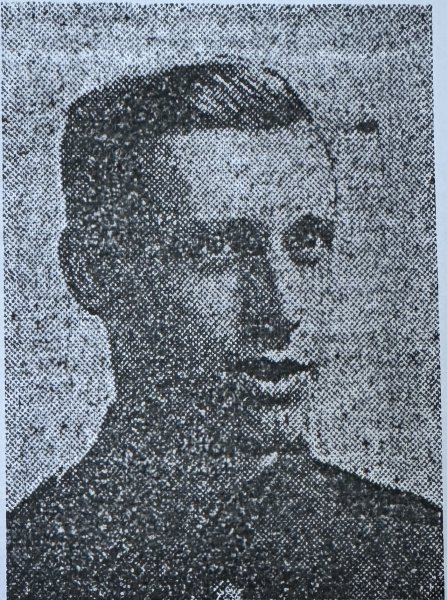 2844 Private 1st/8th Bn, Royal Warwickshire Regiment d 05.05.1915 24y Henry George Bird ("Harry") was born in Kirkley in 1890, the son of a well-known fish mer-chant, Edward Bird and his wife Anna. In 1901 the family lived at 2 Wilson Road, Kirkley, and later moved to "Glenmore", The Avenue, South Lowestoft. Henry was admitted to the Secondary School in September 1904, after earlier attendance at Morton Road Council School. He left school in 1907 and went on to do teacher training at Salt-ley College, Birmingham, and at Roman Hill Council School. At the outbreak of the war he was an Assistant Schoolmaster at Victoria Road School, Oulton Broad. He enlisted in Birmingham in the Saltley College Company (Territorial Force) of the 1st/8th Royal Warwicks and, after training in Essex, crossed to France on 22 March 1915. The Bn, as part of 143 Bde, 48 Div, trained near the garrison town of Bailleul, close to the French-Belgian frontier, and later went into wet trenches in this area. Harry Bird was a stretcher bearer and rapidly became ill in the appalling conditions which prevailed. He died on 5 May 1915 and is buried in the London Rifle Brigade Cemetery (Grave 1.C.8), Comines-Warneton, Hainaut, Belgium. In a letter to Harry's parents, his Platoon Commander, Lt P Docker wrote "His death in my opinion was due to a gradual collapse, a nervous breakdown, followed by heart failure" He wrote highly of his work as a first-aider, and de- scribed him as a compassionate man, always cheerful. His name is on the Lowestoft Roll of Honour and on the Pakefield War Memorial.
BLANCHFLOWER, Percy Robert
302183 Private 2nd Bn, Argyll and Sutherland Highlanders d 10.10.1918 24y The 1901 census shows Norfolk-born Horace Blanchflower, a fish salesman, with his wife Victoria and four children, Violet, Percy, Horace and Rita, living at 34 Denmark Road, Lowestoft. Percy (b Lowestoft, January 1894) attended Roman Hill Council School and went on to the Secondary School in September 1907, supported by a Lowestoft scholarship. His brother and two sisters also attended the Secondary School. He passed the Cambridge Local Examinations for Juniors in July 1910 and for Seniors in the following year. He enlisted at East Dereham, Norfolk, served in the 2nd Bn (Princess Louise's) Argyll and Sutherland Highlanders and was killed on 10 October 1918 during the final stages of the war. After four years of trench warfare, movement had become more fluid again, as the German army conducted a fighting retreat towards its own frontiers. The Bn was part of 98 Bde, 33 Div and on 10 Octo-ber, took part in a fiercely contested attack on the line of the River Selle, 20 km ESE of Cambrai. Percy Blanchflower's body was not recovered and he is commemorated on Panel 10 of the Vis-en-Artois Memorial, Pas de Calais. On this memorial are the names of more than 9000 men who fell between 8 August and 11 November 1918 in the fierce fighting which accompanied the advance to victory in Picardy and Artois, between the Somme and Loos sectors of the battle-front. Percy Blanchflower was awarded the Military Medal during his service but, as there were normally no citations for this medal, the circumstances surrounding this award are not known. His name is also on the Lowestoft Roll of Honour and on the Memorial Board of the former St John's Church..
The Military Medal (reverse side). The ribbon of this medal has broad dark blue edges flanking a central section of three narrow white and two narrow crimson stripes.
BOARDLEY, Harold Augustus
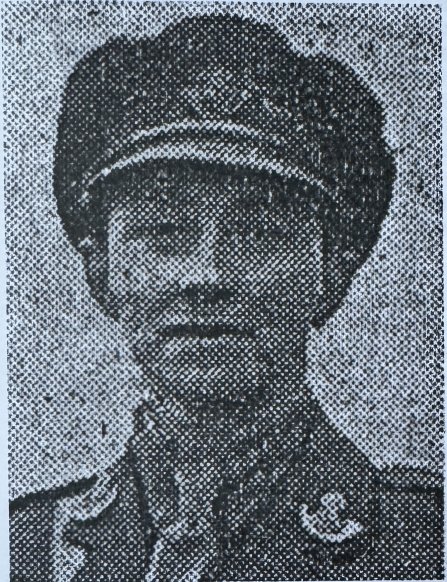 110352 Lieutenant 8th Bn Kings Shropshire Light Infantry d 26.9.1917 20y Harold Boardley was born in Lowestoft in May 1897, the 4th son of Henry and Agnes Board-ley. In 1901 the family lived at 186 Denmark Road, Lowestoft, and Henry was described as a smack-owner. By 1914 they were living at "Sunnyhill", The Avenue, south Lowestoft, and Henry was in charge of the firm of H R Boardley Ltd, Fish Sales-men, and was a Town Council-lor. Harold was enrolled in the Preparatory Class of the Secondary School in September 1906 and moved up into the main stream two years later. He attested in the Inns of Court OTC in May 1915, was commissioned in the 8th Bn KSLI soon afterwards, and served with them in Salonika, Macedonia. At the end of December 1916 he went sick with enteric/ paratyphoid, which left him with a heart problem and he was transferred to Malta for a medical board at Intarfa Military Hospital. He embarked for England on 24 May 1917 on the Hospital Ship "Dover Castle", but the vessel was torpedoed in broad daylight by UC67 on 26 May, when about 50 miles N of Bona, Algeria. The U-boat captain, Karl Neumann, was tried for war crimes after the war but was acquitted on the grounds that the "Dover Castle" was escorted and zigzagging in contravention of the Hague Convention, and therefore a permissible target. The "Dover Castle" sank, but not before her patients were transferred to an escorting destroyer, and only 7 lives were lost. Harold Boardley eventually completed his journey on the P and O steamer SS
"Nore" In London he faced another medical board in June 1917, was passed fit for general service, and joined the 7th KSLI in Flanders just in time to take part in the Passchendaele campaign. As part of 8 Bde, 3rd Div, the Bn played their part in the storming of Zonnebeke. The attack on Hill 40 began at 0530h on 26 September 1917 with the 7th KSLI in support of the 8th East Yorkshire Regt., who succeeded in taking the enemy front line. At 0700h the Bn took over the advance towards the second line and forced the western slopes of Hill 40, taking 70 prisoners and capturing eight machine guns and a 77 mm artillery piece. Although counter-attacked at 1830h the Bn consolidated its position in spite of exposed flanks. The gain of 2500 yards in the day was large by western front standards. Lt Boardley was one of five officers of the 7th KSLI killed in this action, and in addition the Bn lost 36 ORs killed and 27 missing. The GOC 3 Div congratulated the Bn on parade on 3rd October for their gallant conduct on 26th September. In a letter to Councillor H R Board-ley, the commanding officer of the Bn wrote as follows. "I am writing on behalf of the Bn to offer you our deepest sympathy in the death of your son who was killed in the attack on September 26th. I trust it will be a consolation to you to know that he fell gallantly at the head of his men. Your son had not been with this Bn long but I had already formed a high opinion of him. He was a most capable and efficient officer.." Harold Boardley's body was not recovered and he is commemorated on the Tyne Cot Memorial (Panel 112), Zonnebeke, Belgium. His name is also on the Lowestoft Roll of Honour. His older brother, Bert, served in the London Rifle Brigade and was captured near Arras in late March 1918.
BRIGGS, Allan Douglas
G/27794 Lance Corporal 4th Bn Royal Fusiliers d 16.08.1916 19y Allan Briggs was born in Hull in January 1897. In 1901 the family were living in Islington, and his father Henry, (born in Ipswich), was described as a shipping wharf foreman. They later moved to Lowestoft where they lived at 10 Dene Road, and Allan attended the British School from where he won a Lowestoft scholarship to the Secondary School in September 1909. By then Henry Briggs had died and it must have been a struggle for his widow Sarah to finance the education of her son. The publication Soldiers died in the Great War (HMSO) records that Allan was resident in Eastbourne when he enlisted there, probably in 1915, in the 4th Bn Royal Fusiliers. In August 1916 the Bn was in 9 Bde 3rd Div, in action on the Somme battlefield. On 15th August the 3rd Div relieved the 55th Div in the sector just east of Trones Wood and the next day attacked east towards Guillemont. This village was pivotal in the German defensive line and had been entered twice on 30th July and 8th Au-gust, but not held due to flank weaknesses. X and Z Companies of the 4th Royal Fusiliers led the attack at 1740h on 16th August, after a short but intensive bombardment, and their objective was a strongpoint immediately south of the Trones Wood- Guillemont track. Both Company Commanders were killed in a hail of machine gun fire as they crossed the parapet, and every other officer was killed or wounded. In addition there were 160 OR casualties, including Allan Briggs, and the badly weakened unit was left to hold the original front line under heavy shelling until 28th August, when they were relieved and passed to brigade reserve. The Guillemont regimental history describes the action starkly as "a discouraging episode". Alan Briggs's body was not recovered for burial. His name appears on the Royal Fusiliers panel (Pier 8, Face C) on the Thieval Memorial to the Missing which commemorates over 72,000 men who died in the Somme sector and have no known graves.
CASTLETON, Claude Charles
1352 Sergeant Sth Company, Australian Machine Gun Corps d 29.07.1916 23y Sgt Claude Castleton VC was a source of inspiration to Lowestoft Secondary Schoolboys between the two World Wars through the example of his adventurous life and gallant death. He was born in April 1893 in south Lowestoft, the son of a builder, Thomas Charles Castleton, and his wife Edith Lucy. He attended the nearby Morton Road Council School and went on to the Secondary School in 1905. He left school in July 1910 having passed the Cambridge Local Examinations with 3rd Class Honours. He was later a pupil teacher at his old elementary school but at the age of 19y he emigrated to Aus-tralia. There he travelled extensively in Tasmania, Victoria, New South Wales and Queensland, working on farms, sheep stations and as a gold prospector. The outbreak of the War found him in Port Moresby, New Guinea, where he volunteered for coastal defence duties. He enlisted in the Australian Army in March 1915 and went with the 18th Australian Bn to Gallipoli where his leadership qualities started to become apparent and he was promoted Corporal. In March 1916, now a Sergeant, he transferred to 5th Machine Gun Company and his unit was posted from Egypt to France. In July 1916 it formed part of 5 (NSW Bde, 2nd Australian Div, in the Somme sector. The village of Pozières was captured on July 26th but the Pozières Heights had yet to be won when the action occurred in which Claude Castleton earned his Victoria Cross.
Australian War Memorial, Canberra. A commemorative plaque was placed in South Cliff Congregational Church by the family. The church is now St Augustine's (Roman Catholic). Claude Castleton's name is also on the Lowestoft Roll of Honour. A good illustrated account of his life can be found in V Cs of the Somme. A Biographical Portrait by Gerald Gliddon. Claude Castleton is buried in Pozières B C, Ovillers-la-Boiselle, Somme (Grave IV.L.43).
COLLINS, John Henry
18257 4th Bn Coldstream Guards d 30.11.1917 Private 19y John Henry Collins was born in May 1898 in St Leonards, the second son of George and Annie Collins. In 1901 his father kept a butcher's shop in Leicester but had moved to 30 Sussex Road, Lowestoft, by 1911 when John enrolled at Lowestoft Secondary School. He had previously attended London Road Elementary School. At school he was a successful sportsman and in 1913/14 was a member of both the Football XI (see photograph p35), and the Cricket XI (p 12). He left school in July 1914 to become a learner in the Post Office. He enlisted in the Coldstream Guards in Ipswich in 1916 giving his place of residence as Waddington, Lincs. In November 1917 he was serving with the 4th Bn of the Coldstreams, a Pioneer Battalion in the Guards Division, when they took part in the Battle of Cambrai. On 20 November 1917, the British 3rd Army launched a surprise attack on the German lines using nearly 400 tanks, the first mass use of this weapon in military history. The Germans counter-attacked in force on 30 November and by 0900h had captured the village of Gouzeaucourt. The Guards Brigade, including two Bns of the Cold-streams, were pushed forward and succeeded in recapturing the village and much lost equipment later in the day. In heavy fighting 25 Nov - 5 Dec the Coldstream Guards lost 45 officers and 787 men, including John Collins. He is buried nearby in the Metz-en-Couture Communal Cemetery, British Extension (Grave 11.E.21), three km west of Gouzeaucourt. His name is also on the Lowestoft Roll of Honour.
DEXTER, Archibald James
7977 Sergeant 97 Squadron, R A F d 28 October 1918 20y In 1901 the Dexters were a large family with seven children, living at 39 Stanley Street, Lowestoft. The father Albert Edward (b Birmingham) was a Fish Buyer and was married to a Lowestoft girl, Isabella. Several of the children were born in Milford Haven where the family lived for several years in the early 1890s. Archie Dexter, however, was born in Lowestoft in March 1898 and was educated first at the British School, and then at the Secondary School from September 1909. He was small in stature height 5' 5¼", chest 31") and was only 17 years old when he enlisted in the Royal Flying Corps (then a branch of the Army) in August 1915. He was promoted Airman 1st Class in Feb 1917 and, after transfer to the newly formed RAF on 1st April 1918, Corporal Mechanic in July 1918. He crossed to France in March 1916 but was invalided back to England from Le Treport in August 1917 suffering from pulmonary oedema. He was promoted Sergeant whilst undergoing aviation training and in September 1918 he gained his Observer wing. It is likely that Sergeant Dexter's work involved the operation of armaments and early wireless equipment. After training he joined 97 Sqn, serving with the Independent Force from Xaffevillers airfield, near Nancy in the Vosges region of France, from where they undertook night bombing raids into Germany during the last few weeks of the War, flying the huge Handley Page 0/400 aircraft The Independent Force was a relatively little known branch of the RAF, and the forerunner of Bomber Command in WW2. Night-flying conditions were grim, with the crew in freezing open cockpits, sick with fumes and lack of oxygen. More aircraft were lost due to accidents and technical failure, than were shot down by the enemy. The circumstances of his death are described briefly in a report in the Lowestoft Journal of 16 Nov 1918. The Captain of his Squadron wrote to Archie's parents "He was a most effective NCO, engaged in special work of great importance....He was killed in a most unfortunate accident whilst carrying out duties in the air." A further letter from his Lieutenant added "death was almost instantaneous and he suffered no pain. He was buried with full military honours." It was especially tragic that this accident should occur only two weeks before the Armistice. He was buried in Charmes Military Cemetery (Grave 1.D.8), Essegney, Vosges, France, with the three other members of his crew, 2nd Lt K Attwater (pilot, aged 19), 2nd Lt H Holmes (observer, aged 18) and Sgt H Ritchie (aged 20).
DRUMMOND, Clarence Reginald
15550 Lance Corporal 2nd Bn Suffolk Regiment d 02.03.1916 20y Clarence Reginald Drummond was born in Leeds in October 1895, the son of a railwayman, Robert Liddle Drummond and his wife Ellen. In 1901, when the census was taken, Ellen and her two sons and two daughters were living in Potternewton, and her husband was not at home at the time. As a railway family they moved around a good deal and the two oldest children were born in Gateshead. By the time of the Great War they had moved to Lowestoft and lived at 32 Kirkley Park Road. Reginald attended the nearby Morton Road Council School and enrolled at the Secondary School in September 1908. During the War he served in the 2nd Bn Suffolk Regiment, one of the two regular battalions. At the outbreak of hostilities the Bn was in Ireland but went straight from there to France in mid-August 1914, and were soon involved in fighting and in the retreat from Mons. In 1915 came their introduc tion to the mud of trench warfare in the Ypres salient, vividly described by Reginald in a letter to the editor of The Lowestoftian... "A" Company, 2nd Suffolk Regt. BEF The Editor, The Lowestoftian. I have received your post-card asking for a contribution to our magazine, and as at present I have some quiet moments during a period of relief from the Trenches, I thought you might like a letter from "Somewhere in France" Our battalion has been in the trench area (quite a lot of time in the trenches themselves) for about 3 months now, but I think the most trying time was the week commencing Sept. 25th. On that night we were in support for some Scottish regiments who were to make an attack. The usual terrific bombardment took place and then over the parapet went "Jock". After the assault the Suffolks were put in the trenches. Of course we knew we were in for a trying time and our expectations were not by any means disappointed. A fierce counter-attack took place every night and on Thursday the Germans blew up two mines under our Trenches and immediately charged across the breach, and after fierce hand-to-hand fighting occupied a portion of our Trench. On Saturday our Company was detailed to head the assault to shift the Germans. We charged up the slope and after several hours fighting managed to recapture our Trench. This short synopsis of just clear facts will show you that the old school has been represented in some very hot fighting, because, given time and no censor, I could have made a much better story. This is a fearful country. Everything seems against one. The roads are mere apologies and it only wants to threaten rain for them to be ankle deep in mud while five minutes rain sends you down to knee deep. Then every crawling insect under the sun seems to be represented. Flies, wasps, all seem to resent Tommies presence.
What few people there are left here are making little gold mines. They come round selling small luxuries at about 10 times the ordinary price. So I think taking all things together—Krupp's whiz-bangs Gas—Liquid Fire Native rob- bers-Insects-Give me old England and Roll on when the war is over. I shall be pleased to receive a copy of the Mag. when published. Iam, Yours sincerely, C. Reginald Drummond The above letter was written soon after the Bn had been in trenches in the Sanctuary Wood area, four km E of Ypres. They were still in the same area a few months later when, on 2nd March 1916, wearing their newly issued steel helmets for the first time, the Bn went over the top at 0420h around "the Bluff', ', a ridge near the Ypres-Comine canal, 5 km SSE of Ypres. This feature had been captured by the enemy in February. The attack was a complete success but the Bn suffered grievously and there were 250 casualties, nearly half of the attacking force. L/Cpl Drummond was one of those killed and his body was not recovered He is commemorated on Panel 21 of the Menin Gate Memorial to the Missing and his name is also on the Lowestoft Roll of Honour and the Memorial Board of the former St John's Church, Lowestoft. His parents remained in Lowestoft and his father was buried in Kirkley Cemetery in May 1940. The burials register described him as a Retired Manager, LNER.
DUNNETT, William Lewis Ray
573167 Rifleman 2nd/17th Bn County of London Regiment d 20.02.1918 20y Christened William Lewis Ray Dun-nett, he was known as Ray to his family and friends. He was born in January 1898 in Oulton Broad, the son of a fisherman (later boat owner), William John Dunnett and his wife Alice. They lived at 2 Broadway Villas, Oulton Broad. Ray attended the Victoria Road Junior School, from where he went on to Low-estoft Secondary School in January 1912. He left school in July 1913 and became a junior clerk in a Fish Merchant's office. In 1916 he enlisted in the 2nd/6th Bn Suffolk Cyclists (No.2111) but was later transferred to the 2nd/17th Bn County of London Regiment (Poplar and Stepney Rifles). This Bn was brigaded with three other London Regiments in 180 Bde, 60 Div, served in the Middle East and took part in the successful attack on Jerusalem in December 1917. For his "gallant and distinguished services in the field" Ray Dunnett was twice Mentioned in Dispatches (23.10.1917 and 16.12.1917) by the GOC, General Sir Edmund Allenby. After the capture of Jerusalem the Division had a few weeks of rest and consolidation and leave was taken in Cairo and Alexandria by many of the men. The next target for 60 Div was Jericho, about 16 miles to the east along a good metalled road. The main Turkish line of defence crossed this road at Talat-ed-Dumm, midway between Jerusalem and Jericho. The advance started on 19 Feb 1918 and involved an eastward descent of the Judean range of hills, over bleak and difficult terrain. At 0515h on 20th Feb, a heavy bombardment of Talat-ed-Dumm began to which the Turks responded vigorously. The advancing Bns of 180 Bde found the position strongly held but advanced unchecked and by 0700h had taken strategically important high ground at Khan Hathrurah. Talat-ed-Dumm fell 15 minutes later to the 2/19th County of London Regiment. By the morning of 21st Feb the Div had reached all its objectives overlooking the Jordan valley and the ANZACS later swept on to take
Jericho. Ray Dunnett lost his life in this operation and he was interred in Fara District Military Graves, nr Talat-Ad-Dumm. In 1920 the bodies in this cemetery were exhumed and re-interred in Jerusalem Military Cemetery where Ray Dunnett lies in Grave T 91. In The Carlton Colville Chronicles of Canon Reginald Augustus Bignold (ed J R Goffin), in his diary entry for 30 May 1918, Canon Bignold writes "Splendid! Ray Dunnett has been awarded the Military Medal posthu-mously?" However, I cannot find any evidence to support this statement, and it seems likely that the Rector misunderstood the nature of Ray Dunnett's award or was misinformed. The MM is not among the medals in the possession of Ray's surviving brother, Ronald Dunnett, and there is no index card for him on the Military Medal Roll at the PRO.
FIELD, William James
155624 Second Lieutenant 1st Bn Royal Fusiliers d 31.07.1917 23y William Field was born in Beccles in October 1893. His father, Walter Sidney Field, was a tailor and lived with his wife Rebecca and at least six children at 80 Denmark Road, Beccles. William attended the Beccles National School and from there he won a County scholarship to Lowestoft Secondary School, which he attended between September 1907 and July 1911. He passed the Cambridge Local Examinations for Juniors in July 1910 and, in the following year, the Senior Examinations with Honours (gaining distinctions in history, English, geography and religious knowledge). After further training at St Mark's College, Chelsea he became a schoolmaster at West Hill London County Council School, and lived in Fulham. Whilst at college he was a member of the Officers' Training Corps. He volunteered as a private soldier in December 1914 in the 2nd/2nd London Regiment (2/3307) and went with them to Malta, Egypt and then Gallipoli, where he served for the last three months of that campaign. In late January 1916 he became ill with jaundice and was invalided to England on the Hospital Ship "Marama". After recovering his health, whilst serving with the 1st/13th London Regiment at the RE Camp, Fovant, near Salisbury, he applied for a commission in October 1916. He trained at the Officer Cadet Bn, Oxford, and in March 1917 he was commissioned 2nd Lt in the 6th Bn Royal Fusiliers. He was later posted to the 1st Bn Royal Fusiliers in Flanders and on 7th June 1917 took part in the Battle of Messines near St Eloi. The fighting began with the explosion of a number of huge mines and at first there was little organised resistance and good progress was made. A quotation from the regimental history by O'Neill vividly describes William Field's contribution. "But the swiftness and completeness of the Fusiliers' success was due to their splendid dash. Second Lieutenant Field, with a handful of D Company, rushed a strong point which was holding out and captured 25 prisoners and two machine guns" • By 1630h all objectives had been gained. A few weeks later, on 31st July 1917, the small village of Passchendaele became the focus of one of the bloodiest battles of WW1. As part of 17 Bde 24 Div, the 1st Royal Fusiliers were serving in the sector of the I pres Salient near Mt Sorrel just west of Shrewsbury Forest and took part in the attack on a defensive feature known as Lower Star Post. 2nd Lt William Field fell in this action and his body was not recovered. He is commemorated on the Beccles War Memorial and on the Menin Gate Memorial to the Missing
FRANCIS, Sidney George
41234 2nd Bn Essex Regiment d 26.12.1916 Lance Corporal 25y Born in Lowestoft in 1891, Sidney Francis was the eldest son of George and Annie Francis. In 1901 they lived at 17 Edinburgh Road, Lowestoft, and George worked as a draper's porter. The family later moved to 6 Oxford Road. There were then two other children, Alfred (b 1896) and May (b 1900). Sidney attended the Secondary School from 1904, in its first year of existence, and later became a teacher at Roman Hill Council School. He married Edith S M Newson in the summer of 1915. He enlisted early in the War at Lowestoft in the Suffolk Regiment 33541) but later transferred to the 2nd Bn Essex Regiment ("the Pompadours") and was serving with them in France when he died on Boxing Day 1916. The Bn fought on the Somme battlefront in the Serre sector throughout July 1916 and were then switched to the Ypres salient in early August. There followed a period of intensive training before returning to the Somme in early October 1916 where they went over the top on 23rd Oct just E of Lesboeufs in the Battle of Transloy ridges. The Bn suffered 255 casualties in this attack and on 3rd Nov went into reserve at Bouillancourt for rest and rehabilitation. This was complicated further by an outbreak of mumps and measles which spread with great rapidity. On 6th Dec the Bn moved to Frégicourt where they relieved the French in an exhausting operation over several days in conditions of heavy rain and appalling mud. Over 140 men had to be evacuated to hospital during the month before they left the line on Christmas Eve. Sidney Francis died on Boxing Day and was buried in St Sever Cemetery, Rouen (Grave O.IV.A. 1) in a base area with many Military Hospitals. The publication Soldiers Died in the Great War (HMSO) does not specify that he died of wounds and it seems more likely that he succumbed to illness brought on by prolonged exposure to arduous battle conditions over a six-months period. His name is on the Lowestoft Roll of Honour. His wife Edith lived at St Margaret's Gardens, Beccles Road, Lowestoft, after the War.
GAGE, George Frederick
11th Bn Suffolk Regiment 43180 Private d 24.10.1918 21y George Gage grew up in north Lowestoft, where his father William Henry Gage was a cab proprietor operating from stables in Crown Street close to the Crown Hotel. Born in February 1897, he was bap-tised in the parish church of St Margaret's a few weeks later. He attended St Margaret's College (a private School) and was admitted to Lowestoft Secondary School in April 1912 at an older age than usual. After passing the Cambridge Local Examinations for Juniors in July 1913, he left school to become a clerk in the Borough Accountant's Office at the Town Hall. By then his father was a Job Master and lived with his wife Fanny at 52 Park Road, Lowestoft. George Gage enlisted at Ipswich in the Suffolk Cyclists Bn (2316), a unit with an excellent training record which frequently supplied reinforcements to other Bns of the Suffolks. In the final stages of the War George was serving with the 11th Bn Suffolk Regiment which, as part of 61 Div, took part in the Battle of the Selle. At 0400h on 24th October 1918 the Div attacked over the River Ecaillon, and within two hours the 11th Suffolks had taken all its objec-tives, together with 110 prisoners and some trench mortars and machine guns. The enemy vigorously counter-attacked the leading Company, forcing them to form a defensive flank. At nightfall the enemy withdrew from Vendegies under pressure and early next morning the line of objective was established. On 25th October the Bn marched to St Martin and La Folie to re-organise. The total Bn casualties for the month of October, most of them in the Battle of the Selle, amounted to 274 and these included George Gage, killed in action. He is buried nearby in Vendegies Cross Roads Cemetery, Bermerain, Nord, (Grave B.11). It was his misfortune to be one of the last casualties suffered by his Bn in the War. His name is also on the Lowestoft Roll of Honour.
JEFFERY, John Alwyn
2879 Private 23rd Bn London Regiment d 19.04.1915 22y In 1901, Alfred Jeffery (spelt Jeffrey on some documents), a bootshop man-ager, lived in New Market Place, Beccles, with his Australian-born wife Jeannie and three sons, of whom John Alwyn was the oldest (b 1893). After elementary education in Beccles, John was awarded a County scholarship and attended the Secondary School in Lowestoft from September 1906 to 1910, and left after obtaining a pass in the Cambridge Local Examinations for Sen-iors. He was resident in Walton-on-Thames just prior to the Great War and enlisted early at Clapham Junction in the 23rd Bn London Regiment. The Bn trained in London and in the St Albans area before embarking at Southampton for Le Havre on the SS Copenhagen on 14 March 1915. They formed part of 6 Bde, 2 Div, and on 11th April 1915 entered trenches at Richebourg (between Neuve Chapelle and Festubert), for instruction under the 1st Guards Bde. In this part of the Loos sector the high water table meant that conventional trenches were impossible, and the front consisted of a series of small redoubts, connected by breastworks without parados. A chronic shell shortage on the British side meant that no reply was possible to steady shelling from the en-emy. Sniping was severe and accounted for most of the casualties suffered by the Bn. Thanks to the trenchcraft of their mentors, who took endless pains to instruct the Bn, these were relatively light amounting to one officer wounded and two other ranks killed, six wounded, between April 11th to 19th. Sadly, John Jeffery was one of these and died of wounds in No 1 Casualty Clearing Station, Chocques, 4 km NW of Bethune, on 19 April 1915. He is buried nearby in Chocques Military Cemetery (Grave I. A.72). His name is also commemorated on the Beccles War Memorial.
JENKINS, Brian Henry Bentley
1st/12th Bn London Regiment 471688 Rifleman d 07.10.1916 19y The Jenkins family were well-known photographers in Lowestoft for about a century, and operated their business from 2 Pier Terrace in the early 1900s. Brian was the eldest son of Harry Jenkins and his wife Mary, and was born in February 1897. After elementary education at Roman Hill Council School he attended the Secondary School from September 1909. Although resident in Lowestoft, he enlisted in London in the 1st/12th (County of London) London Regiment, widely known as The Rangers. On 1 July 1916, the first day of the Somme offensive, the Bn went over the top at 0720h and, after initial gains, were held and suffered severe casualties. They fought later in the Battle of Ginchy (9 September 1916) and by October 1916 were seasoned veterans of the Somme battles. On the night of 6 October 1916 they moved into a new position and had to dig in at dawn under shellfire. At 1345h on Saturday 7th October 1916, as part of 168 Bde 56 Div, the Rangers attacked the enemy's Dewdrop Trench, 1 km NE of the village of Lesboeufs. This trench had previously been softened up with a barrage from Stokes mortars as it was too close for artillery bombardment. By 1349h, in the face of withering fire, the attack had failed and Brian Jenkins and many of his comrades had been killed. The remnants of the Bn lay out in shellholes until dusk when they returned to their original lines. Brian Jenkin's body was not recovered for burial and his name appears on Pier 9, Face C of the Thiepval Memorial to the Missing. Mean-while, Brian's father Harry Jenkins was experiencing difficulties in running his photographic business in Lowestoft under tight "Defence of the Realm Act" restrictions. In 1914 and 1915 he was cautioned several times by the police for taking photographs without a permit in sensitive areas. Finally, in March 1916 he was prosecuted in Lowestoft Magistrates Court for refusing to cooperate with the police and for carrying photographic equipment without permission near a military installation on North Parade. When first arrested Harry's uncooperative attitude led to him being detained in a police cell for nearly 24 hours. He was subsequently found guilty on both charges and fined. It is somewhat ironical that Brian's brother, Ford Jenkins, became well-known for his work as an official photographer recording events in the town during the 1939-45 War, resulting in the publication of a popular book Port War. Another brother, Ralph Jenkins, also an Old Boy of the Secondary School, had a distinguished career as an officer in the Royal Navy in WW2.
JOHNSTONE, James
TR10/183103 Private 53rd TR Bn Royal Sussex Regiment d 23.10.1918 18y James Johnstone was only eight months old at the time of the 1901 census and was the youngest Old Boy of Lowestoft Secondary School to die in the War. In 1901 the family lived at 1 Ashby Road, Lowestoft, and consisted of James, his mother Emma and his Scottish-born father, also James Johnstone, who was a tailor, draper and outfitter. The family later moved to 88 Denmark Road, Lowestoft. James junior attended the Secondary School from 1910 and passed the Cambridge Local Examinations for Juniors with Class III Honours, in July 1915. Afterwards he was in the employment of Lowestoft Corporation Electricity and Tramway Depot. He enlisted at Bury St Edmunds and at the time of his death he was still under training at Aldershot in the 53rd Bn Sussex Regiment. He died of pneumonia on 23 October 1918 after a very short illness at a hospital in Aldershot, and his body was brought back to Lowestoft for burial. He was thus one of the victims of the influenza pandemic which ravaged the world in 1918, killing more people than were lost in the fighting during the whole War. His grave in Lowestoft cemetery (D82) is marked by a Commonwealth War Graves Commission headstone and his name is on the Lowestoft Roll of Honour. James had a younger brother, Robert Walton Johnstone (b 1912), who attended the Secondary School between 1920 and 1925. He became a major in the Seaforth Highlanders and was killed at El Alamein in October 1942.
JONES, Douglas Norman
9185 7th Bn Suffolk Regiment d 03.07.1916 Private 20y Douglas was the eldest son of Norman and Mildred Jones, and was born in Lowestoft in March 1896. His parents both hailed from the London area but settled in Lowestoft in the 1890s and in 1901 they lived at 64 Beresford Road. Norman Jones was a Fish Salesman, and by the time of WW1 the family had moved to "Bournville", The Avenue, south Lowestoft. Douglas attended the British School and was admitted to the Secondary School in April 1910. During the War he enlisted at Lowestoft in the 7th Bn Suffolk Regiment. This Bn crossed to France on 30 May 1915 and within three weeks the troops were in the trenches in the Ypres Salient in Flanders. They went on to see further action in 1915 in the Loos sector in France, where one of their officers, Lt Charles Sorley, a well-respected war poet, was killed. At the beginning of July 1916 the Bn was switched to the Somme battlefield, and at 0300h on 3 July, under the command of Major GH Henty, took part in the assault on the village of Ovillers, five km NE of Albert. The first waves got as far as the enemy's third line, and elements reached the village itself, but in the darkness succeeding waves lost touch, enabling the Germans to surge in and cut them off. The attack was thus brought to a halt after severe fighting in which the Bn suffered heavy losses and all four Company Commanders were killed. The total casualties were 470 of all ranks and in the words of Lt Col C C R Mur-phy, the regimental historian, "Thus, at the battle of Albert, was this fine battalion almost destroyed" '. Douglas Jones was reported missing after this attack and later confirmed as killed in action. His name is commemorated on Pier 1 Face C of the Thiepval Memorial to the Missing, but is not on the Lowestoft Roll of Honour.
MALLETT, Cecil Horace
Sub-Lieutenant Anson Bn Royal Naval Division, RNVR d 12.04.1918 21y Cecil Mallett was the only son of Frank Cecil and Edith Mary Mallett, and was born in Low-estoft in January 1897 and baptised at St Margaret's Church. In 1901 the family lived at 61 Norwich Road, Lowestoft and Frank Mal-lett worked as a ship-builder's clerk. Cecil had one sister, Dorothy (o 1900), who died tragically young in March 1911. Cecil Mallett was a pupil at Church Road Junior School and won a Lowestoft scholarship for secondary education. He attended the Secondary School from September 1909 to 1914, passed the Cambridge Local Examinations for Seniors with Class III Honours and won a scholarship to Bede College, Durham. In December 1915 he left college and enlisted in the 6th Suffolk Cyclists Bn. This Bn never went overseas as a unit but served as a Coastal Defence unit and furnished high quality drafts for the western front, mainly to other battalions of the Suffolks. Cecil Mallett went overseas as a L/Cpl in July 1916. After five months in the field he was recommended for a commission in December 1916 and trained at Lichfield from where he was gazetted Sub-Lieutenant in the RNVR in June 1917. Two months later he crossed to France to join the Anson Bn, RN Division, which fought as an infantry formation on the western front. The Bn, together with the Howe Bn and the Ist and 2nd Royal Marines, formed 188 Bde, and in February 1918 were holding a section of the line on the northern arm of the Flesquières Salient. Conditions were quiet at first but on 12th March 1918 they suffered a prolonged bombardment with mustard gas. Early on 21st March 1918, after a ferocious artillery bombardment, the German Army launched the "Michael" offensive, in a final attempt to break the Allied line. The RN Div held its positions well at first but were later forced to retire in good order to conform with retreats on both flanks. Over the next week there followed a series of rearguard actions via High Wood until the line stabilised just east of the River Ancre near Thieval. By then the average Bn strength in the Bde had been reduced to about 250
men. Cecil Mallett was wounded in the later stages of this retreat and on 11th April 1918 he was admitted to the 5th British Red Cross (Lady Hadfield's) Hospital, Wimereux, dangerously ill, and wounded, with contusions to the legs and arms. He died the next day and was buried in the Wimereux Commonwealth Cemetery, Pas de Calais, (Grave IV.C.1). His name is also on the Lowestoft Roll of Honour (as a 2 Lt in the 6th Suffolks).
MANTRIPP, George William
5376 Lance Corporal 2nd/1st Bucks Bn, Oxford and Bucks LI d 19.07.1916 22y In the 1901 census the Mantripp family consisted of George James Mantripp, a shipwright, with his wife Mary, daughters Lois (6 1890) and Agnes (b 1900), and his only son George William (b February 1894). They lived at 64 Wilson Road, Kirkley, in the early 1900s, and George William was a pupil at the nearby Morton Road Council School. From there he joined the Secondary School in September 1908. He enlisted early in the War at Walthamstow, and trailys ved i this Buck Ben othe Oxford and Bucking he hat big Infantry which was in trenches near Richebourg, NE of Béthune, in the Loos sector of the western front. Further south, the Battle of the Somme was raging, and in an attempt to prevent the enemy transferring troops to reinforce that sector, an attack was launched at 1800h on 19th July. Already weakened by a gas attack the previous day and by intensive shelling, the Bn was mown down by machine-gun fire and few reached the enemy parapet, and none returned. Every officer in the assaulting companies was killed or wounded. Stanley Wood, another Old Boy of the school serving in the 2nd/1st Bucks, fell in the same attack. There is a short paragraph about George Mantripps's death in the Lowestoft "Journal" of 9th September 1916. This included excerpts from a letter to his parents from a comrade who wrote as follows. "George was in our platoon and commander of my section, and always looked up to as a good, honourable and straightforward man. He was leading his section in an attack on the morning of 19th July 1916 when hit by a bullet in the neck, killing him instantly as he turned his head to shout encouraging words to his men." George Mantripps body was not recovered and he is commemorated on Panel 83 of the Loos Memorial to the Missing. His name is on the Lowestoft Roll of Honour.
MUMMERY, Ivan Herbert
Third Officer SS "Baku Standard", MN d11.02.1918 19y Ivan Mummery is the only Merchant Navy man recorded on the School War Memorial. He was born in July 1898 in Lowestoft, the eldest son of John Herbert and Mahala Florence Mummery, of 25 Kirkley Park Road, south Lowestoft. His father was a fish merchant. Ivan was educated at Morton Road Council School, from where he entered Lowestoft Secondary School in September 1910, one of the first classes to use the new School building. He left in July 1913 to become an apprentice in the Merchant Service. On 11th February 1918 he was serving as Third Officer on the SS "Baku Stan-dard" (3708 gr t) of Swansea, when the vessel was sunk by a torpedo, 5 ml S by W½W from Tod Head (near Stonehaven), off the east coast of Scotland. The vessel was on a voyage from the Clyde to the Firth of Forth, with a cargo of crude oil. In all, 24 lives were lost, including Ivan Mummery. His body was recovered and he was buried in Kirkley Cemetery. A naval detachment from Lowestoft attended and the "Last Post" was sounded over his grave. One of the wreaths was from "Dad, boys and girls". His father was by then a widower, following the death of Mahala Mummery in August 1916. Ivan Mummery's name is also Commemorated on the Merchant Navy Memorial, Tower Hill, London, but it does not appear on the Lowestoft Roll of Honour
PEARMAN, Arthur William
2991 Private 2nd/7th Bn Royal Warwickshire Regiment d 29.07.1916 24y Arthur Pearman was born and grew up in the parish of Ashby, near Somerley-ton. In 1901, his father, also Arthur Pearman, was a woodman and lived in an estate cottage with his wife Eliza and their four children, Eliza (b 1891, Arthur (b 1892), Frances (b 1894) and Henry (6 1897). Arthur junior attended the Somerleyton Village School and, in September 1906 at the age of 14, won a County Scholarship to Lowestoft Secondary School. By then his mother was a widow and life must have been hard for her with four young children to raise. After leaving school Arthur Pearman entered the service of Messrs Devereux and Sons, grocers, as a clerk. He enlisted at Rugby, Warwickshire, in the 2nd/7th Bn Royal Warwickshire Regiment, a Territorial unit formed early in 1915. After training on Salisbury Plain the Bn, as part of 182 Bde, 61 Div, crossed to France at the end of May 1916 and underwent further training near Bethune. On 19th July 1916, whilst in trenches at Fauquissart, in front of Laventie, the Bn took part in an extensive attack which at first penetrated deeply into the enemy's defences and inflicted heavy losses, but which had to be abandoned later in the day, at a price of 300 casualties. Field Marshal Haig described the enterprise as a gallant effort, which was by no means in vain. It had accomplished its purpose which was to impress on the enemy the risk he would run if, in order to reinforce the Somme front, he weakened the line else-where. Arthur Pearman was wounded in this attack, evacuated to England, and died on 29th July 1916 in Keighley Hospital (Yorkshire). There is an account of his funeral in Keighley (Morton) Cemetery, in the Lowestoft "Journal" of 21st October 1916. "He was buried with full military honours. His body was carried through lines of soldiers to an evergreen-lined grave. A firing party fired three volleys and the Last Post was sounded." Two of his sisters at- tended the funeral. Arthur Pearman's name is on the War Memorial Tablet in St Mary's Church, Ashby, along with that of his younger brother Henry ("Jack"), who was killed on the Somme in October 1916 when serving with the 7th Suffolks.
POPPY, Harry Charles
89 Private 54th Casualty Clearing Station, RAMC d 13.08.1915 20y The 1st/1st East Anglian Field Ambulance was a Territorial Force unit based in Lowestoft. One of the single largest tragedies of the Great War for the town was the sinking of the troopship SS "Royal Edward" on 13 August 1915 when taking troops to Gallipoli. This vessel carried the 54th Casualty Clearing Station, RAMC, which included the Lowestoft Territorial unit, and twelve local men, including Harry Poppy, perished in this incident (see photograph p40). Harry Poppy, born in Lowestoft in May 1895, was the son of Norfolk-born Herbert Harry Poppy and his wife Alice. Harry had an older brother, Frank (b 1892), and in 1901 the family lived at 89 Arnold Street, Lowestoft. At that time his father worked as a grocer's carman. Harry was a pupil at Church Road Junior School and was admitted to the Secondary School in April 1909. The "Royal Edward" was sunk in the Aegean Sea, near the island of Kos, by the German submarine UB 14 (Lt Heino von Heimburg) which was operating from a secret base at Bodrum on the Turkish coast. The "Royal Edward' was struck full on the stern by a torpedo and there were fewer than 500 survivors out of 1366 troops and 220 crew. One of the survivors later de scribed how there was some confusion after the torpedo struck when those on deck ran below to fetch their life jackets and met those below trying to find their way up. Those drowned in this tragic incident are commemorated on panels of the Helles Memorial to the Missing, an obelisk on top of the Gallipoli peninsula. Harry Poppy's name is also on the Lowestoft Roll of Honour.
SHEPHERD, William
885194 Gunner 117th Bty, 26 Bde Royal Field Artillery d 25.07.1921 23y William Shepherd was born in Lowestoft in October 1897, the second son of John Charles Shepherd, a smack-owner, and his wife Florence Ellen. In 1901 the family lived at 17 Beresford Road, Lowestoft, and William then had two brothers, John (b 1893), Edward (b 1898), and two sisters, Florence (b 1895) and Gladys (b 1900). Another brother, George, was born in 1911. By 1911 they had moved to 19 Royal Avenue. William attended Church Road Junior School and moved on to the Secondary School in September 1911. During the Great War, William served in the Royal Field Artillery in France and was badly gassed. He married Violet Agnes Harrison in Norwich in the Spring of 1917, and they had a son Brian William John (b 1918). After the War they lived at 29 Douro St, Norwich, and in 1920, William was ordained a priest in the Church of Latter Day Saints. However, his health had been ruined by his wartime experiences, and on 25 July 1921 he died from the delayed effects of the gas poisoning. He was buried with full military honours in Norwich Cemetery (J383), as reported in the Lowestoft "Journal" of 6th August 1921. "The coffin of polished oak, covered with the Union Jack, was borne on an artillery limber drawn by six horses from 11th Bde RFA, stationed at the Cavalry Barracks. The cortege was headed by the British Legion band which played Chopin's Funeral March". Pall bearers, and trumpeters to sound the Last Post came from the Depot, the Norfolk Regiment. After his death, William Shepherd's name was added at the foot of the list on the School Memorial Tablet. It is also on an addenda panel in the War Memorial Chapel in St Margaret's Church. There is a large Shepherd family plot in Lowestoft Cemetery (R470) on which one of the headstones bears an inscription in memory of William, and also of his older brother L Cpl John Shepherd RE, who died in January 1925, aged 31 y. They were pre-deceased by their sister Gladys, who died in March 1919 at the age of 18 y. Their parents lived in Warren Road, Lowestoft between the Wars, and later at Geldeston.
WARBY, Stanley Albert
475299 Private 88th Field Ambulance, RAMC d 04.10.1917 24y There is some confusion about the given names of Stanley Albert Warby. On the In Memoriam list in the school magazine The Lowestoftian, his name appears as Stanley Arthur Warby, but this is incorrect. It is likely that he used Stanley as his main given name, although on some documents he appears as Albert Stanley. His parents, John and Jane Warby, hailed from the London area, and their children, Gertrude (b 1882), Jessie (b 1888), Stanley Albert (b 1892) and his younger brother Frank (6 1899), were all born in that area. By 1901, however, they had moved to Lowestoft where the family lived at 26 Maidstone Road and John Warby was employed as a storekeeper in a builder's yard. The family later moved to 363 London Road South and during the Great War they lived at 52 Church Road. Stanley Albert Warby attended the Secondary School from 1905 to 1910, and on leaving had obtained a pass in the Cambridge Local Examinations. He went on for teacher-training at Peterborough College and later taught at Melton Constable C S, in Norfolk. He enlisted at Norwich in the RAMC and was a member of the Territorial Force. He married Ida Mary Smith in the Spring of 1917 and they made their first home with her parents at 65 Rotterdam Road, Lowestoft. Only a few months later, at the time of the Third Battle of Ypres, he was wounded whilst serving with the 88th Field Ambulance. He subsequently died from these wounds on 4th October 1917 at Duhallow Advanced Dressing Station, one mile north of Ypres, and he is buried nearby in Du-hallow ADS Cemetery, (Grave VII.F.6). Stanley Warby's name is on the Lowestoft Roll of Honour and is also on the Memorial Board of the former St John's Church in South Lowestoft. This church was pulled down after World War 2 and the Hon-ours Board is now in the War Memorial Museum in Sparrow's Nest, Lowestoft.
WARD, Frederick James
7147 Private 1st/6th Durham Light Infantry d 01.10.1916 22y Frederick Ward was born in November 1893 and attended the Secondary School from September 1907. At that time the family lived at 126 Morton Road, Kirkley, and Frederick had formerly been a pupil at the nearby Morton Road Junior School, from where he was awarded a Kirkley scholarship for secondary education. Frederick's father, John Lambert Ward, was then a boat-man, and at the time of his death in 1932 was described as a pleasure-boat owner. His mother Ellen died in 1927. Frederick enlisted in the 1st/6th Durham Light Infantry which crossed from Folkestone to Boulogne on 14 April 1915 and spent most of the next 16 months in the Ypres Salient. In mid-August 1916 the Bn was switched to the Somme sector, trained for several weeks near Baizieux, and from 15th to 17th September took part in an attack near Bazentin-le-Petit. On 1 October 1916, the first day of the action which became known as the Battle of the Transloy Ridges, they formed part of 151 Bde, 50 Div. A preliminary bombardment began at 0700h but some shells fell short causing 40 casualties, including the wounding of Major G E Wilkinson, the CO of the 1st/6th Durhams. At his request, Lt Col R B Bradford, the CO of the 1st/9th Durhams, took over command of both Bns, and the attack was launched at 1515h. A foothold was gained in Flers Trench, (3 ml E of Cource-lette, but suffering in the wake of the neighbouring 1st/17th London Regiment's lack of success, their right flank became severely exposed. At this stage Lt Col Bradford arrived on the scene in the forward area and took charge of the situation, and by 2130h Flers Trench had been secured. Enemy counter-attacks during the night were repulsed and a communications trench was dug back. For his conspicuous bravery and outstanding leadership that day Lt Col Bradford was awarded the Victoria Cross. Frederick Ward was killed in this day's fighting and he is commemorated on the Thiepval Memorial to the Missing (Pier 14 Face A). The name F J Ward, Royal West Kents, appears on an Honours Board in Lowest-oft Town Hall (see photograph left), and it is possible that he served with this regiment at some time. His name is also on the Lowestoft Roll of Honour and on Pakefield War Memorial.
WOOD, Stanley
5342 Lance Corporal 2nd/1st Oxford and Bucks Light Infantry d 19.07.1916 19y Although only 19 years old when he died of wounds in France, Stanley tragic experience y ben they in which several of his friends lost their lives. On the Whitsun weekend of 1914, a group of Sea Scouts from the 1st Carlton (St Mark's) Troop camped at Somerleyton, trav-elling by river. On Whit-Monday they embarked above the railway bridge for the return journey and, heavily laden with camping gear, rowed under the bridge before attempting to raise sail. In a gusty N wind the boat gybed and capsized, throwing everybody in the water. Stanley Wood was thrown clear and was able to swim ashore and run for help. The six other occupants of the boat, (the Scoutmaster, an Instructor and four Scouts) were drowned. They were buried in Carlton New Cemetery after an impressive fu- neral conducted by the Bishop of Norwich. Stanley Wood was born in November 1896, the son of Charles Wood, the Sanitary Inspector for Lothingland District Council. The family home was Ivy Cottage, Beccles Road, Oulton Broad. Stanley was a pupil at St Mark's School, Carlton Colville, and joined the Secondary School in September 1910 following the example of his older sister, Doris (b 1895), who had been a pupil since 1907. Stanley enlisted in Lowestoft and served in the 2nd/1st (Bucks) Bn of the Oxford and Bucking-hamshire Light Infantry. He died of wounds received in France on 19 July 1916 in the same action that George Mantripp lost his life (see account on p36). He is commemorated on Panel 83 of the Loos Memorial to the Missing, and his name is also on the Memorial Tablet in St Peter's Church, Carlton Colville, and on the Lowestoft Roll of Honour. In The Carlton Colville Chronicles of Canon Reginald Augustus Bignold (ed J R Goffin), in his diary entry for July 1915, the Rector wrote "He was a bright, clever boy, respected and popular with everybody. I told him that God had reserved him for greater things—and surely it was true"
WRIGHT, William Reginald
(3402) (1st/5th Bn London Regiment) (d 09.10.1916) (Rifleman) (23y) The Secondary School Honours Board simply bears the name W Wright and there is some confusion in that there were two former pupils of the school with that name who appear to have died in the 1914-1918 War. On the In Memor-iam list which appeared in The Lowestoftian soon after the War, the full name was given as William Reginald Wright. A boy of this name was admitted to the Secondary School in September 1906, at the age of 13 years 6 months and left in April 1908. He had earlier been a pupil at Church Road Junior School and little is known of his family background. The Secondary School Admissions Register gives his address simply as The Smack Boys Home, Battery Green, Lowestoft, and states that his father, William Wright, "had left the town" William Wright is a very common name and it has been difficult to identify his service career with certainty. The only man with the correct full name in the publication Soldiers Died in the Great War (HMSO) served in the 1st/5th London Regiment (London Rifle Brigade). His place of birth is not given and he was resident in Muswell Hill when he enlisted. His service details and date of death are given in the headings above in parentheses to indicate the uncertainty with regard to identification. This uncertainty should also be taken into account when reading the following brief statement about the circumstances of his service and death. The London Rifle Brigade went over the top on the first day of the Somme campaign (1 July 1916) as part of 169 Bde 56 Div in the attack on the village of Gommecourt at the extreme northern end of the British sector. The Bn was still on the Somme battlefield in October 1916 when 56 Div took part in the Battle of the Transloy Ridges in the sector just east of the village of Lesboeufs. William Reginald Wright was reported killed in action on 9th October 1916. His body was not recovered for burial and he is commemorated on the Thiepval Memorial to the Missing, (pier 9, Face D). William Wright's name does not appear on the Lowestoft Roll of Honour.
WRIGHT, William Victor Allen
22901 6th Company, Army Ordnance Corps d 17.11.1918 Private 21y William Victor Allen Wright was the eldest son of a Lowestoft boat-owner, William John Wright, and his wife Rhoda Frances. In 1901 the family lived at 145 St Peter's Street, Lowestoft, and consisted of two daughters, Rhoda and Ivy, and two boys, William (6 Lowestoft, 1897) and Sidney. Another son, Frederick, was born a few years later. William was educated at a pr-vate school until October 1906, when he entered the Preparatory Class of the Secondary School. By then the family had moved to 88 Clapham Road where they stayed until the Great War. Brothers Sidney and Frederick followed William to the Secondary School in 1911 and 1913 respec-tively, at the new premises in Yarmouth Road William satisfied the examiners at the Cambridge Local Examinations for Junior Boys under 16 in July 1913, and left school to work in the office of a Fish Salesman on the Fish Market (possibly the firm of Peacock & Co, where his brother Frederick later worked.) William did not enjoy robust health and during the War was clas- sified accordingly, and did not enlist until about 1916, when conscription was introduced. He served as a clerk in the Army Ordnance Corps in France and sent home an interesting series of picture postcards, many of them in 1917 from the base town of Rouen, to his sister Mrs Rhoda Balls. These are now in the possession of Rhoda's daughter, Mrs Gwen Cubitt, to whom I am indebted for much information and the loan of photographs. Meanwhile the family moved to Reedham for the duration of the War to escape the bombardmen and bombing from which Lowestoft suffered. Tragically, although William Wright survived the War unscathed, he succumbed to the influenza pandemic
of late 1918 and died of broncho-pneumonia in No 5 Stationary Hospital, Dieppe on 17 November 1918. He is buried in a military plot in the civil Jan-val Cemetery (grave 1.V.6), Dieppe. His name appears on the Reedham War Memorial and a brief account of his life is given in the book Reedham Remembers by Noel Morris. His name is also commemorated on a plaque in the Fishermen's Bethel in Lowestoft, where his father was an elder, and on the Lowestoft Roll of Honour.
Medals and Decorations With one exception, all of the men served overseas in a theatre of war and were thus eligible for the award of two of the WW1 Service (campaign) Med-als, ie the British War Medal and the Victory Medal. The exception was the youngest of those who died, 18 years-old James Johnstone, who was serving in a training battalion in October 1918, when he was struck down by the influenza pandemic and died of pneumonia. In addition, some of the men, who served overseas before the end of 1915, earned the 1914 Star or the similar 1914-15 Star. It is a source of great pride to the Lowestoft Secondary School that four of the 27 men were also decorated for bravery. These were Sgt Claude Charles Castleton Victoria Cross 2 Lt William James Field Military Cross Pte Percy Robert Blanchflower Military Medal Rin William Lewis Ray Dunnett Mentioned in Dispatches Further details of these awards, where known, are given in the individual biog-raphies. Ray Dunnett would have been eligible to wear an Oak Leaf clasp on his Victory Medal. Sgt Castleton's Victoria Cross was passed on to the Australian War Memorial, Canberra, by the family, but a replica set of his medals, can be seen, with his portrait, in Lowestoft Town Hall.
Sources and References The sources used in compiling this book have been many and varied. Whilst great pains have been taken to check material carefully it is inevitable that errors and omissions will be found and the author welcomes notification of these for a possible later edition. Local sources Back files of the Lowestoft local newspaper The Journal 1914 to 1921. Most wartime issues contained a photo-gallery of servicemen on the back pages. There were also obituary announcements and news items relating to individual servicemen Available on microfilm (Lowestoft branch of the Suffolk Record Office), or in original form (Loweston Heritage Workshop Centre). The 1901 Census ( microfiche, Record Office; or www.census.pro.gov.uk). Baptisms, Burials, Marriage Registers of Lowestoft parishes (Record Office). Kelly's county and Lowestoft street directories (Record Office). Lowestoft School of Science: admission register 1900-1936. This ledger, recently deposited in the Lowestoft branch of the Suffolk Record Office, includes entries for all the men on the Secondary School Roll of Honour. Lowestoft Secondary School: admission registers 1910-onwards. These ledgers are at the Denes High School. They overlap and duplicate the register described above. The starting date coincides with the move to the new buildings in Yarmouth Road in 1910. Early issues of The Lowestoftian, the magazine of the Lowestoft Secondary School. Armed Forces sources The Commonwealth War Graves Commission Register (www.cwgc.org. Soldiers Died in the Great War HMSO. Officers Died in the Great War HMSO. Lloyds War Losses- the First World War casualties to shipping through enemy causes, 1914-1918. The History of the Suffolk Regiment, 1914-1927 Lt.Col. C C R Murphy. Other regimental histories were also consulted. An excellent collection of these is available at the Reading Room of the Imperial War Museum, London. The London Gazette (www.gazettes-online.co.uk). Files of the Public Record Office, Kew. The following were especially useful:- Medal Roll Indexes WO329 Soldiers' Records W0363, 364 Officers' Records WO339 (Army), ADM337 (RNVR) RAF Records, AIR79 50